Repellents, clothing, netting and other personal protection measures can help prevent mosquito bites and the diseases they carry.
Insect repellents are effective and safe when properly used. Use the information below to select the repellent that best fits your exposure to mosquitoes.
Recommended Products
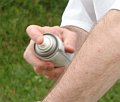
DEET
DEET is a reliable and highly effective insect repellent. The chemical has been in public use since 1957.
The repellent is sold under numerous brand names and comes in lotion, spray and many other forms.
Concentrations of DEET range from about 5% all the way up to 100%. Products with 10% to 35% DEET will provide adequate protection under most circumstances. Products with concentrations higher than about 50% do not offer significantly greater protection. For example, 50% DEET provides about 4 hours of protection against mosquitoes, but increasing the concentration to 100% gives only about one extra hour of protection.
DEET should be used with proper precautions, especially in children, who can experience irritation or other reactions after swallowing or prolonged skin application. However, if DEET products in moderate concentrations are used according to directions, they are considered safe. The American Academy of Pediatrics recommends that repellents used on children contain no more than 30% DEET. MSDH generally recommends using repellents with up to 10% DEET on children.
IR-3535
IR-3535 is used as an insect repellent against mosquitoes, deer ticks, and biting flies. Long used in Europe, it can be expected to provide long-lasting protection for those seeking a non-DEET product.
Picaridin
Picaridin, also known as KBR 3023, is an effective alternative to DEET products which provides long-lasting protection against mosquito bites, comparable to about a 10% concentration of DEET. This repellent has been used worldwide since 1998. Compared to DEET, Picaridin is nearly odorless, does not cause skin irritation, and has no adverse effect on plastics.
For Clothing: Permethrin

Permethrin is effective both as a pesticide and as a repellent. It is not for use on the skin, but is intended for clothing.
Unlike DEET, Permethrin can retain its potency for at least two weeks, even through several launderings. It can be applied to clothing, tent walls, and mosquito nets. The combination of Permethrin-treated clothing and DEET products applied to skin can offer excellent protection against mosquito bites even in demanding conditions.
Other Effective Products

Oil of Lemon Eucalyptus
Oil of lemon eucalyptus (p-Mentane-3,8-diol, or PMD) is the synthetic form of an ingredient in eucalyptus leaves and twigs. Oil of lemon eucalyptus has been tested against mosquitoes found in the US, and provides protection similar to repellents with 15%-20% concentrations of DEET. Oil of lemon eucalyptus products have should not be used on children under the age of three due to a lack of testing for this age group.
Note: Oil of lemon eucalyptus and lemon eucalyptus oil are not the same product. Natural lemon eucalyptus oil has not been tested or approved as an effective repellent.
Plant-based repellents
Repellents derived from plants such as citronella, geranium, basil, garlic and peppermint provide only limited protection against mosquitoes. Studies with products containing a mixture of plant oils (citronella, cajuput, lavender, safrole-free sassafras, peppermint, calendula, soy and tea tree oils) have shown them to be modestly effective, repelling mosquitoes for about two hours. Because of their limited effectiveness, they are not recommended.
Oil of citronella products are commonly sold as repellent candles, but these have little effectiveness against mosquitoes. Skin-applied products containing oil of citronella can offer mild protection against mosquitoes.
Safe Application of Repellents
DO
- Use aerosol or pump sprays for treating skin and clothing, except around the mouth or face. Sprays provide a more even application.
- Use liquids, creams, lotions or sticks to more precisely apply the product to exposed skin.
- Wash repellents off skin with soap and water when you return indoors.
- Keep insect repellents out of the reach of children at all times.
DON'T
- Apply to eyes, lips or mouth, or over cuts, wounds or irritated skin.
- Over-apply to the skin, or saturate clothing.
- Apply to skin beneath clothing, or to skin that is not exposed.
- Apply more often than recommended on the product label.